Turkey Entry Ban, Immigration Restriction Codes and How to Remove Them

TUĞTEPE LAW OFFİCE
📞 +90 553 543 27 68
If you are a foreign national who has been refused entry to Turkey, stopped at an airport, deported from Turkey, or told that there is a restriction code (tahdit code) on your immigration record, you may be wondering what this means and whether you can legally return to Turkey.
A Turkey entry ban does not always have the same legal basis. In some cases, it may result from an overstay or residence permit violation. In other cases, it may be connected to a deportation decision, public order or public security assessment, false documents, an immigration violation, or another administrative record.
The good news is that an entry ban or immigration restriction is not necessarily permanent. Depending on the reason for the restriction, the applicable legislation, the evidence relied upon by the administration, and the individual circumstances of the foreign national, there may be administrative and judicial legal remedies available.
This article explains what a Turkey entry ban is, what an immigration restriction code means, what these records can affect, and whether it is possible to have them removed.
What Is a Turkey Entry Ban?
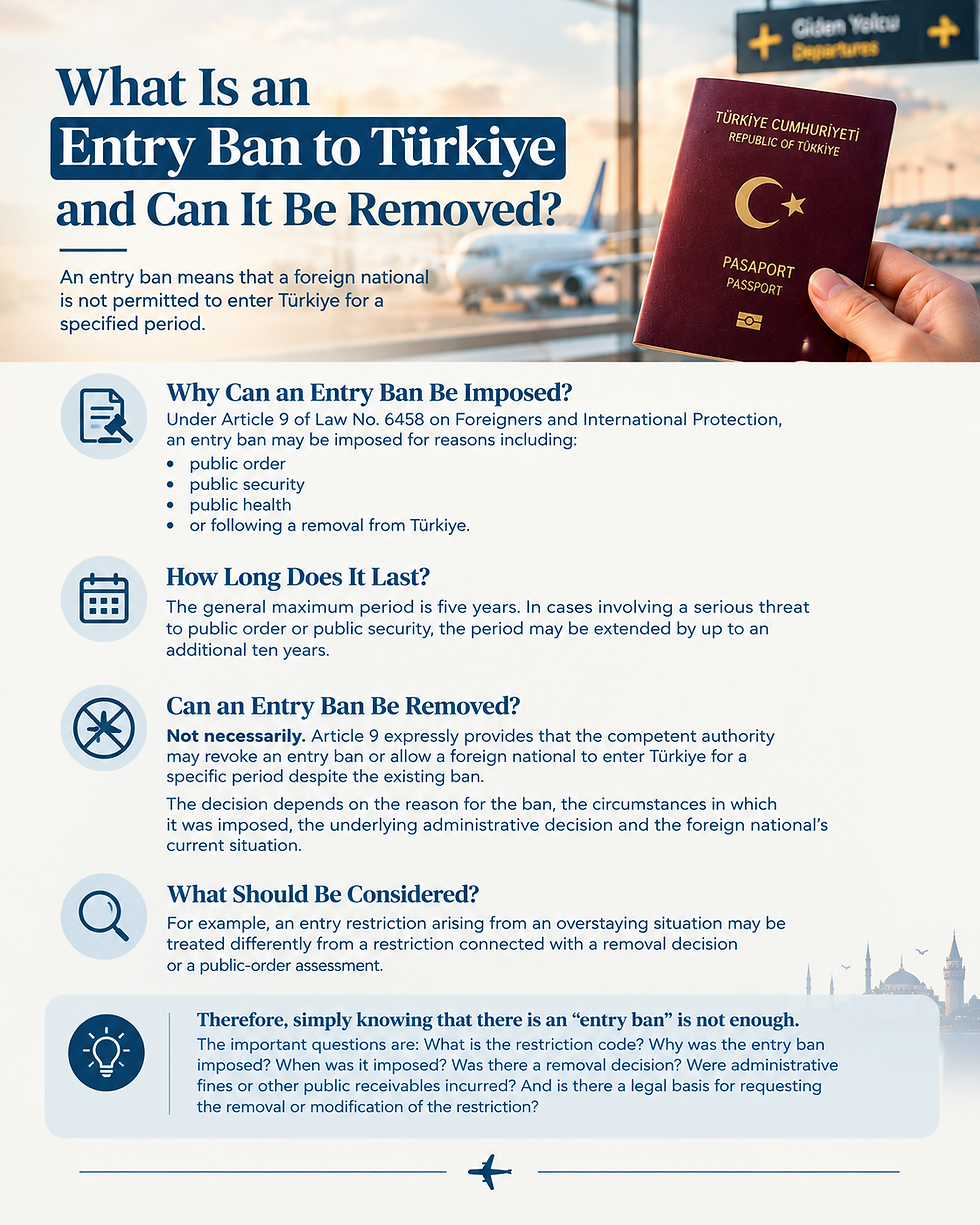
A Turkey entry ban is an administrative restriction preventing a foreign national from entering Türkiye for a specified period.
Under Article 9 of the Turkish Law on Foreigners and International Protection No. 6458, an entry ban may be imposed where the entry of a foreign national is considered objectionable for reasons relating to public order, public security or public health.
An entry ban may also be imposed in connection with a deportation decision.
As a general rule, an entry ban cannot exceed five years. However, where there is a serious threat to public order or public security, the competent authority may extend the ban for up to an additional ten years.
This means that the question is not simply:
“Do I have a ban from Turkey?”
The more important questions are:
Why was the entry ban imposed?
Which administrative decision is behind it?
Is there a restriction code associated with the foreign national?
How long is the restriction supposed to remain in force?
Was the underlying decision lawful and proportionate?
Can the entry ban be cancelled or revoked?
Is there a legal basis for challenging the decision before the Turkish administrative courts?
These questions must be answered by examining the individual's immigration record.
What Is a Turkish Immigration Restriction Code?
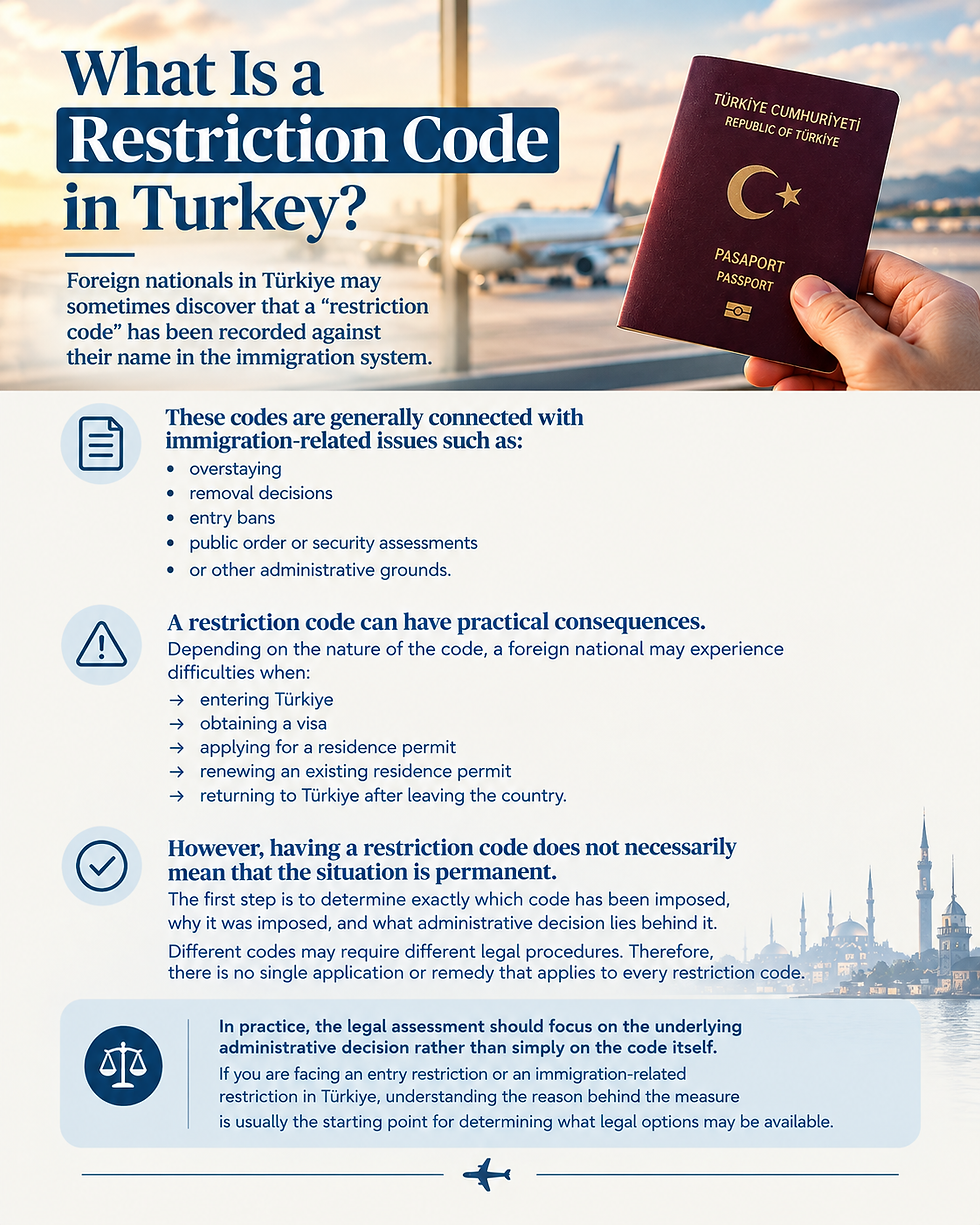
Foreign nationals sometimes hear expressions such as “restriction code,” “immigration code,” “tahdit code,” “security code,” or “deportation code.”
In practice, these expressions generally refer to administrative records entered into the immigration and security systems concerning a foreign national.
The important point is that the term “tahdit code” itself is not a separate statutory offence or independently defined legal institution under Law No. 6458. The legal consequences arise from the underlying administrative decision and the applicable provisions of Turkish immigration law.
Different types of records may have very different consequences.
For example, a foreign national may have a record connected with:
a visa violation;
an overstayed residence permit;
a deportation decision;
a public order assessment;
a public security assessment;
the use of false documents;
an unlawful entry or exit issue;
failure to comply with an immigration obligation;
or another administrative restriction.
Therefore, simply knowing the letter and number of a code is often not enough to determine the correct legal remedy.
Does Every Restriction Code Automatically Mean a Permanent Entry Ban?
No.
This is one of the most important points for foreign nationals dealing with Turkish immigration problems.
A restriction record and an entry ban are related concepts, but they should not automatically be treated as exactly the same thing.
The legal consequences depend on the specific record, the underlying decision and the reason for which the administrative measure was imposed.
In some cases, a restriction may result in an entry ban.
In other cases, the foreign national may face additional controls or administrative consequences without the same type or duration of entry prohibition.
For this reason, a proper legal assessment should begin by identifying the underlying administrative measure rather than relying only on the code shown in the system.
Why Can a Foreign National Receive a Turkey Entry Ban?
There are several possible legal grounds.
1. Visa or Residence Permit Overstay
One of the most common reasons is remaining in Türkiye beyond the period permitted by a visa, visa exemption, residence permit or other lawful stay.
However, the consequences depend heavily on:
how long the violation lasted;
whether the violation was detected before departure;
whether the foreign national voluntarily went to the border;
whether administrative fines were paid;
whether a deportation decision had already been issued;
and whether the foreign national complied with the applicable departure period.
The Presidency of Migration Management has published specific rules concerning entry bans resulting from violations of the right to legal stay. For certain shorter violations, an entry ban may not be imposed where the foreign national voluntarily leaves Türkiye under the specified conditions and pays the applicable administrative fine. For longer violations, entry bans may range from months to several years depending on the circumstances.
Therefore, an overstay does not automatically mean that every foreign national will receive the same entry ban.
2. Deportation From Turkey
A deportation decision can also result in an entry ban.
Turkish immigration law provides for deportation in a number of circumstances, including certain serious immigration violations, unlawful entry or exit, certain public order or public security concerns, and other grounds specified by Article 54 of Law No. 6458.
The existence of a deportation decision and the existence of an entry ban should nevertheless be examined separately.
A foreign national may therefore need legal advice concerning:
the deportation decision + the entry ban + the restriction record.
Depending on the circumstances, these may require different legal arguments and potentially different applications.
Can a Turkey Entry Ban Be Removed?
Yes, in certain circumstances an entry ban may be revoked, cancelled or otherwise overcome through the available legal procedures.
The possibility of removal depends on the legal basis of the ban.
Article 9 of Law No. 6458 expressly provides that the competent migration authority may revoke an entry ban. It may also permit a foreign national to enter Türkiye for a specified period despite the existence of an entry ban.
This is important because an entry ban should not always be viewed as an irreversible obstacle.
However, the correct legal strategy depends on the underlying facts.
For example, a case based on a short-term visa violation is fundamentally different from a case involving an alleged public security concern.
Similarly, a restriction connected to a deportation decision may require a different legal analysis from a restriction resulting from an overstayed residence permit.
How Can a Turkey Entry Ban Be Challenged?
There may be more than one possible legal route.
The first step is to determine exactly what administrative action has been taken against the foreign national.
Depending on the case, the lawyer may consider:
Administrative application
An application may be submitted to the competent migration authorities requesting reconsideration, revocation or removal of the relevant restriction or entry ban.
The application should not merely state:
“Please remove my ban.”
A properly prepared application should explain why the restriction should no longer remain in force or why the underlying administrative assessment should be reconsidered.
Depending on the case, relevant arguments may include:
lack of a sufficient factual basis;
incorrect assessment of the foreign national's circumstances;
disproportionate restriction;
changed circumstances;
expiry or disappearance of the original justification;
family ties in Türkiye;
employment or business interests;
education;
medical circumstances;
compliance with immigration obligations;
absence of a current public order or security risk;
or other legally relevant individual circumstances.
What If the Administrative Application Is Rejected?
If the administration refuses to remove the restriction, a foreign national may, depending on the nature of the administrative act and the applicable procedural rules, have the possibility of bringing an action before the Turkish Administrative Court (İdare Mahkemesi).
This is where the distinction between the underlying administrative decision and the immigration system record becomes particularly important.
A lawyer should identify:
the administrative act being challenged;
the competent administrative authority;
the applicable legal provisions;
the notification date;
the applicable litigation deadline;
the competent administrative court;
whether interim relief or suspension of execution should be requested.
The legal strategy should therefore be determined after examining the actual immigration record, rather than simply based on the code number.
Can I Enter Turkey While an Entry Ban Is Active?
Generally, a person subject to an active entry ban should not assume that they can enter Türkiye simply because they have a valid passport or visa.
The Presidency of Migration Management states that foreigners who are banned from entering Türkiye are among those for whom a visa cannot be issued under the relevant provisions.
There may, however, be specific mechanisms under Turkish immigration law allowing entry in particular circumstances.
For example, the competent authority may revoke an entry ban or permit a foreign national to enter Türkiye for a specified period without removing the underlying ban.
Accordingly, a foreign national should obtain legal advice before purchasing a flight and travelling to Turkey if there is any possibility of an active entry restriction.
What Happens at the Turkish Airport if You Have a Restriction?
A foreign national may discover the problem only when attempting to enter Türkiye.
The person may have:
a valid passport;
a valid visa or visa exemption;
previously lived in Türkiye;
previously held a residence permit;
a Turkish spouse or family members;
a company or business in Türkiye;
and still encounter an immigration restriction at the border.
This is why checking the underlying immigration record before travelling can be extremely important.
A foreign national should not assume that the expiry of an old deportation period or the payment of an immigration fine automatically means that every restriction in the system has disappeared.
The current status of the immigration record should be established.
Can a Lawyer Remove a Restriction Code?
A lawyer cannot simply “delete” an immigration code from the system by making an informal request.
What a lawyer can do is identify the legal basis of the restriction and pursue the appropriate administrative or judicial remedy.
Depending on the case, this may involve:
Reviewing the immigration record → identifying the underlying decision → submitting an administrative application → challenging an unlawful decision before the Administrative Court → requesting appropriate interim relief where legally available → obtaining removal or cancellation of the relevant administrative restriction.
The strategy depends on the actual facts of the case.
What Documents Are Needed to Challenge a Turkey Entry Ban?
The documents required will depend on the circumstances, but a preliminary assessment may require:
passport copy;
previous Turkish visa or residence permit information;
deportation documents, if any;
entry or exit records;
documents showing the restriction or entry ban;
previous correspondence with the Migration Management;
administrative fine documents;
residence permit documents;
employment or company documents;
marriage or family documents where relevant;
court decisions, if any;
documents explaining why the foreign national needs to enter Türkiye.
If the foreign national was refused entry at an airport, any document issued by the border authorities should also be preserved.
Can a Restriction Be Removed Without Going to Court?
In some cases, yes.
An administrative application may result in the competent authority reconsidering and removing the relevant restriction.
However, there is no universal procedure guaranteeing that every entry ban or restriction will be removed administratively.
Where the administration refuses the request, or where the underlying administrative act requires judicial review, an action before the competent Administrative Court in Türkiye may become necessary.
The correct route depends on the specific legal basis of the restriction.
Turkey Entry Ban Lawyer – Why Individual Assessment Matters
Immigration restriction cases are highly fact-specific.
Two foreign nationals may have apparently similar immigration histories but face completely different legal consequences.
For example:
Foreign National A may have overstayed for several months and voluntarily left Türkiye.
Foreign National B may have been deported following an administrative decision.
Foreign National C may have a restriction connected to a public security assessment.
Although all three may say:
“I have a ban from Turkey.”
the appropriate legal strategy may be completely different.
For this reason, an immigration lawyer should first determine why the restriction exists, rather than immediately recommending the same application or lawsuit for every client.
Do You Have a Turkey Entry Ban or Immigration Restriction?
If you have been told that you have a Turkey entry ban, deportation record, restriction code, security code, immigration restriction or border restriction, you should not assume that you have no legal options.
The first step is to determine the exact nature and legal basis of the restriction.
A Turkish immigration lawyer can review your circumstances and assess:
whether an entry ban exists;
what caused the ban;
whether a restriction code is recorded;
whether the restriction can be challenged;
whether an administrative application should be filed;
whether an action before the Administrative Court may be appropriate;
whether the entry ban can be revoked or whether special permission may be available;
and what documents should be prepared before attempting to enter Türkiye again.
Do not wait until you arrive at the airport to discover that you cannot enter Türkiye.
If your family, employment, business, education or personal life requires you to return to Türkiye, obtaining a legal assessment before travelling can help you understand your actual immigration position and identify the appropriate legal route.
Turkey Immigration Lawyer – Entry Ban and Restriction Code Assistance
Our office provides legal assistance to foreign nationals facing Turkey entry bans, deportation-related restrictions, immigration restriction codes, residence permit problems and other Turkish immigration law issues.
Each case is assessed individually because the legal remedy depends on the reason for the restriction and the administrative action underlying it.
If you have been refused entry to Türkiye, deported from Türkiye, or informed that a restriction code has been placed on your immigration record, you can contact us for an assessment of your case and the available legal options.
Frequently Asked Questions
Can a Turkey entry ban be removed?In certain circumstances, yes. Turkish immigration law allows the competent authority to revoke an entry ban, and depending on the underlying administrative act, judicial remedies may also be available.
How long does a Turkey entry ban last?The general statutory maximum is five years, although a serious public order or public security threat can allow an extension of up to ten additional years under Article 9.
Does a deportation automatically mean a five-year Turkey entry ban?Not every case should be treated as automatically producing the same period of prohibition. The reason for deportation, immigration violation, applicable administrative rules and individual circumstances must be examined.
What is a tahdit code in Turkey?“Taḥdit code” is a practical term used for restriction records in immigration/security systems. The legal effect depends on the underlying administrative measure and the specific record.
Can I enter Turkey if I have a restriction code?You should not assume that you can. Some restriction records may result in an entry ban or other border restrictions. The current status of the record should be checked before travelling.
Can a Turkish immigration lawyer challenge an entry ban?Depending on the circumstances, a lawyer may submit an administrative application and/or bring an action before the competent Administrative Court. The appropriate procedure depends on the underlying administrative decision.
What should I do if I was refused entry at a Turkish airport?Keep all documents given to you by the border authorities, do not rely solely on verbal information, and obtain a review of your immigration record and the underlying administrative decision before attempting to travel to Türkiye again.
Can an old restriction remain in the immigration system after the ban period ends?The practical status of an immigration record should be verified rather than assumed. If the person is still experiencing problems at the border after the relevant period, the underlying record and any continuing administrative measure should be investigated.
Conclusion
A Turkey entry ban or immigration restriction code does not necessarily mean that a foreign national has permanently lost the right to enter Türkiye.
The decisive issue is the legal and factual basis of the restriction.
Whether the problem arose from an overstay, residence permit violation, deportation, unlawful entry or exit, false documents, public order concerns or a security-related assessment, the appropriate legal solution should be determined after examining the individual's immigration record.
In appropriate cases, an administrative application, revocation request, judicial challenge or another immigration-law remedy may be available.
If you have a Turkey entry ban or immigration restriction and need to return to Türkiye, the safest approach is to have the restriction legally assessed before travelling.
📞 +90 553 543 27 68


Comments